Laguerre....
In mathematics, the Laguerre polynomials, named after Edmond Laguerre (1834 - 1886), are a polynomial sequence defined by

These polynomials are orthogonal to each other with respect to the inner product given by

Also, for each n, Ln(x) is a solution of Laguerre's equation

which is a second-order linear differential equation with variable coefficients.
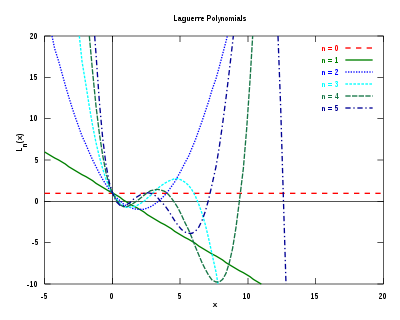
The first few polynomials are:


- and is given by the graph:
-


The polynomials may be expressed in terms of a contour integral

where the contour circles the origin once in a counterclockwise direction.
These are also sometimes called the associated Laguerre polynomials. The simple Laguerre polynomials are recovered from the generalized polynomials by setting α=0:

The associated Laguerre polynomials are orthogonal over  with respect to the weighting function xαe − x:

The associated Laguerre polynomials obey the following differential equation

For integer α the defining equation above can be written as

Relation to Hermite polynomials
The generalized Laguerre polynomials arise in the treatment of the quantum harmonic oscillator, due to their relation to the Hermite polynomials, which can be expressed as

and

where the Hn(x) are the Hermite polynomials.
===============================
ayan! yan ang Laguerre! isa syang special function na una kong narinig mula s aming physics 112 prof n c sir galapon...
grabe...
biruin nyo, may relasyon p pala xa kay pareng Hermite... ("er-mit" ang pagpronounce ayon kay APAPF president... hehehe..)
hndi ko yan makakalimutan....
dinerive q sa loob ng halos isang araw s lib ang recurrence relation nyan n given by:
• 
at
• 
ibibigay ko ang derivation nyan some other time...
pero grabe... hnding hndi ko yta makakalimutan yan sa lahat ng functions.... dahil kht nagbabad kmi s lib ng isang buong araw para magderive ng mga representation ng iba't ibang functions (hndi lang Laguerre, may bessel, legandre, hermite, at mga associated nila..), hndi p rn enough un!
toka p naman sklen ang rodrigues representation nyan, which is, unfortunately, hndi ko nderive...
e malas! nilabas s exam (finals pa!)... yan tuloy, hndi ko nasagot..
sayang!!
but eniweiz.... at least tapos nah yon...
gs2 ko lang balikan...
ang mahal kong so Laguerre....
posted by phisixstewdent at 12:44:00 AM


0 Comments:
Post a Comment
<< Home